
Best Crypto APIs: Overview and Rating


Introduction
Crypto data infrastructure has matured rapidly. APIs now power portfolio trackers, trading bots, tax tools, and institutional dashboards. The category has grown well beyond simple price feeds. Builders today need more than market data. Wallet data, DeFi positions, and on-chain metrics matter. AI agent integration also became a relevant factor in 2026. This article surveys five crypto APIs worth evaluating this year. Each provider serves a distinct slice of the builder market. For developers focused on a single ecosystem, chain-specific APIs are a related category covered in our overview of the top Ethereum APIs. The goal here is to help developers match the right multi-chain tool to the right job.
API Selection Criteria
Choosing a crypto API comes down to fit, not raw feature count. Below are the criteria we used to evaluate providers.
- Coverage Depth: Asset count, exchange count, chain count, and historical depth all matter. A provider tracking 10,000 coins serves different needs than one tracking 100,000.
- Data Categories: Market data, wallet data, DeFi positions, on-chain metrics, and order book depth are separate problems. Few providers cover all five well.
- Performance and Reliability: Latency, uptime, and rate limits define what you can build. WebSocket support also matters for real-time applications.
- Documentation and Developer Experience: Clear endpoint references and code samples shorten integration time. Predictable error handling helps further. SDKs in popular languages reduce custom wrapper work.
- Pricing Model: Credit-based, tiered subscription, and per-call pricing each suit different usage patterns. A free tier matters for prototyping and early-stage products.
- AI Agent Integration: MCP server support became a meaningful differentiator in 2026. Teams building AI-powered crypto products need APIs that expose tools to LLMs directly.
These criteria guided our selection. Each provider profiled below excels in at least three of these areas.
CoinStats API
General Description
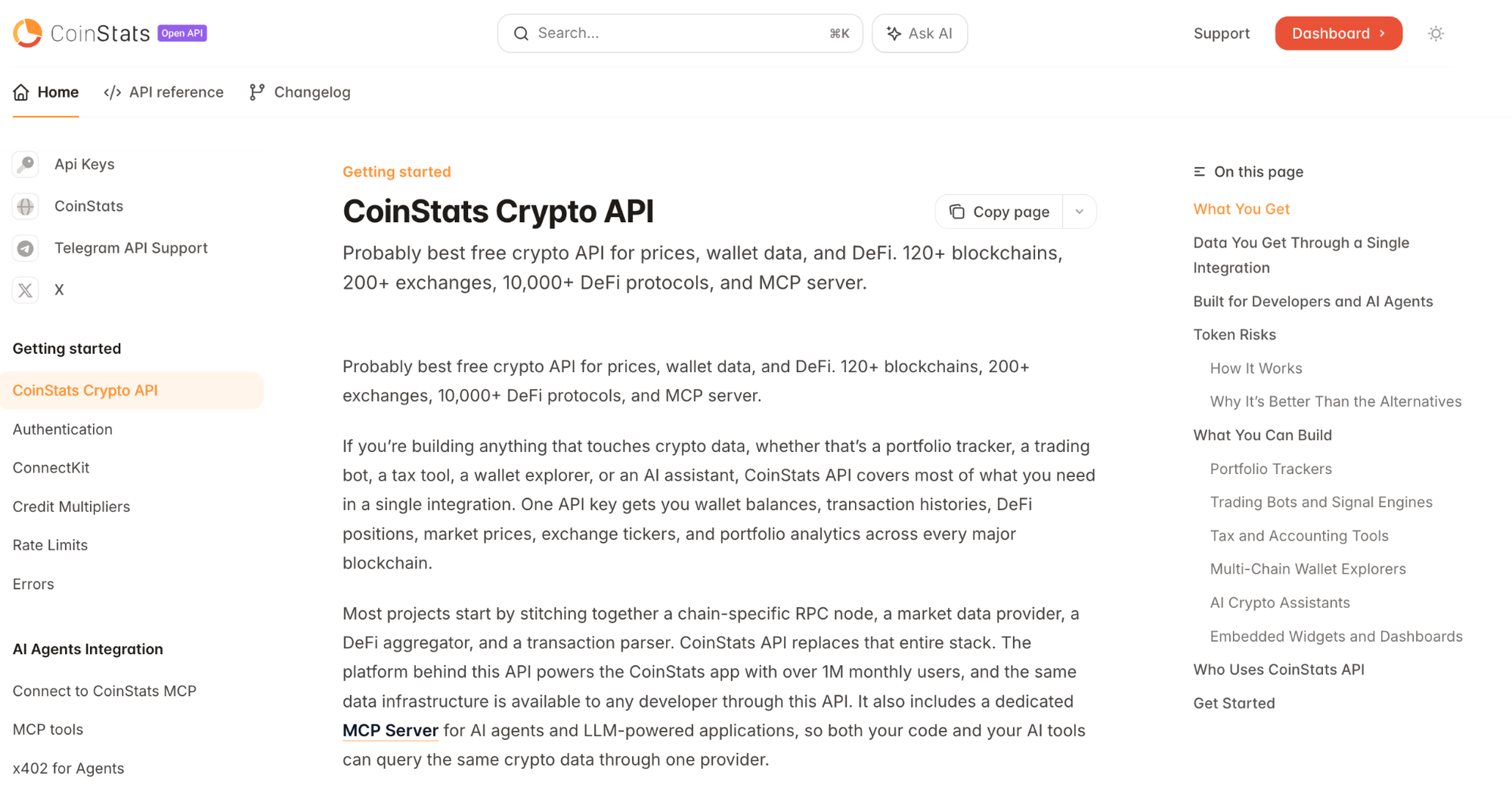
CoinStats Crypto API provides aggregated market data, wallet data, and portfolio analytics from a single integration. Coverage spans 100,000+ coins across 200+ exchanges. Supported venues include Binance, Coinbase, and Hyperliquid. The API also covers 10,000+ DeFi protocols and 120+ blockchains. CoinStats API sits on top of a consumer product serving 1M monthly users. The provider also ships an MCP Server alongside its REST API. That makes the data usable inside AI agent workflows and LLM-powered applications.
Key Strengths
- Unified Market and Wallet Data: Wallet tracking covers Solana, Ethereum, EVM chains, and Bitcoin. Bitcoin support includes xpub, ypub, and zpub address formats. Developers pull balances and transactions alongside pricing without a separate wallet service.
- Per-Wallet DeFi Positions: Coverage extends beyond protocol-level TVL to per-wallet position detection. The API resolves staking, lending, liquidity provision, and yield positions across 10,000+ DeFi protocols.
- MCP Server for AI Agents: REST endpoints come paired with an MCP Server. It exposes wallet, DeFi, and portfolio data to LLMs. Teams can connect Claude, ChatGPT, or other LLM clients directly.
Usage Examples
- Portfolio Dashboards: Build a unified view of wallet holdings and exchange balances. The API returns P&L, allocation charts, and historical performance data without custom aggregation logic.
- DeFi Position Trackers: Surface staking, lending, and LP positions for any user wallet across major chains. Applications show users their full DeFi exposure in one place.
- AI Agent Integrations: Connect an LLM to the MCP Server. The agent can answer wallet queries in natural language. Use cases include AI portfolio assistants, research copilots, and automated reporting.
CoinStats API fits teams building portfolio tools, DeFi dashboards, AI agents, and multi-chain analytics products. The combination of wallet data, DeFi position resolution, and MCP support stands out in the crypto API category.
Mobula
General Description
Mobula provides crypto market data, wallet data, metadata, and DeFi quotes through a single API. The platform emphasizes broad coverage and granularity across chains. Mobula supports SQL queries for advanced filtering and data manipulation. The API offers high flexibility without strict rate limits on most endpoints. A free API key is available for developers who want to start building immediately. Documentation and a developer dashboard simplify onboarding.

Key Strengths
- Broad Chain Coverage: The API supports a wide range of blockchains, including major L1s and L2s. Developers get unified access to data across ecosystems through one endpoint surface.
- SQL Query Support: Mobula lets developers run SQL queries against its dataset directly. That enables custom filtering, joins, and aggregations without building a separate data layer.
- Flexible Rate Limits: Most endpoints allow high request volumes without rigid quotas. That suits teams running indexers, backfills, or analytics workloads with bursty traffic patterns.
Usage Examples
- Market Data Aggregation: Pull real-time and historical prices, volumes, and pair statistics. Coverage spans tokens across hundreds of chains, normalized from multiple sources.
- Wallet Activity Tracking: Monitor transaction history, holdings, and DeFi interactions for any wallet address. Applications can build alert systems and tracking dashboards on this foundation.
- Custom Analytics Pipelines: Use SQL queries to extract specific cohorts, time windows, or asset slices. Research and BI teams reduce post-processing work with the query layer.
Mobula fits developers who want broad coverage and flexible query patterns. The SQL support and minimal rate limiting differentiate it from typical REST-only providers.
CryptoAPIs.io
General Description
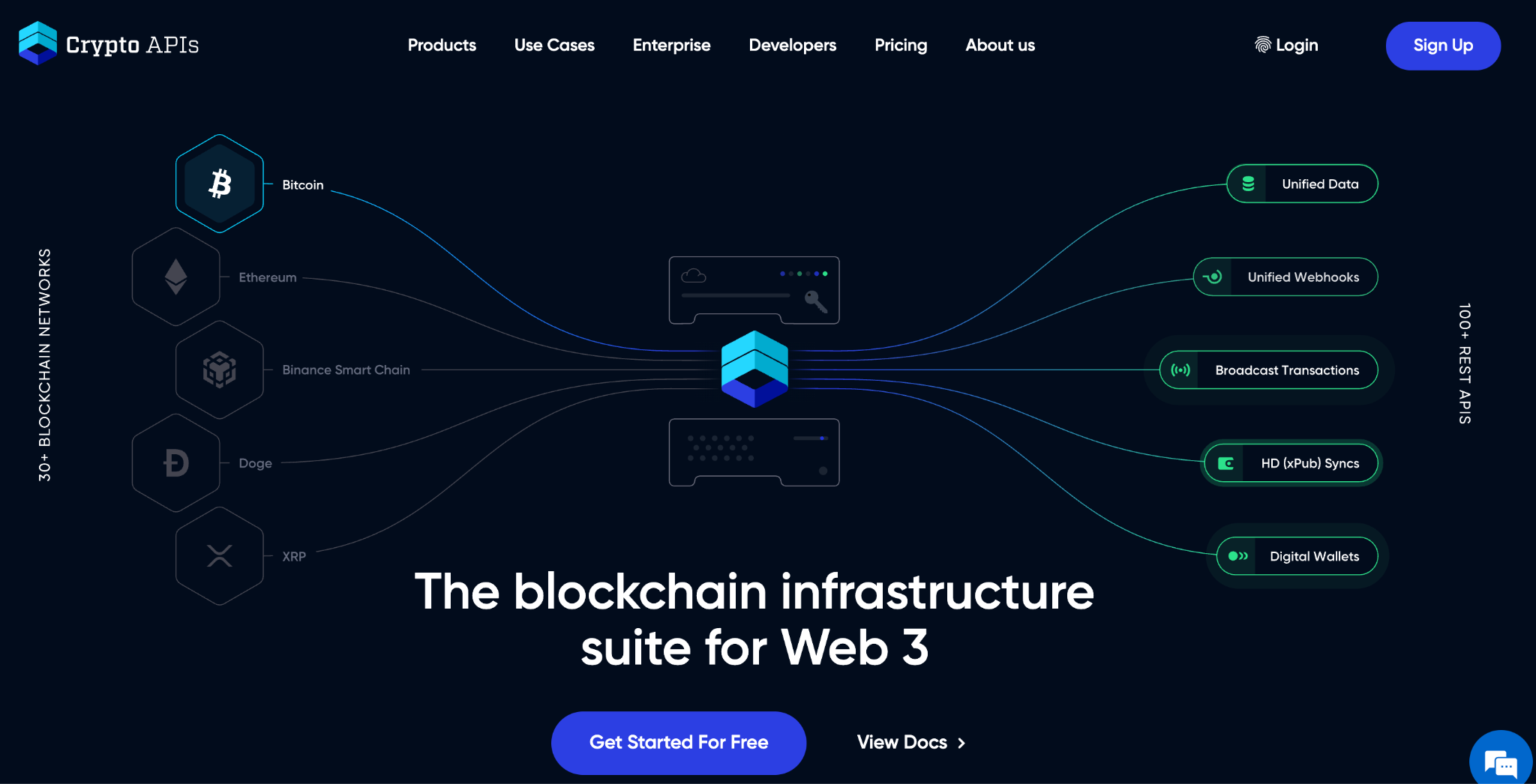
CryptoAPIs.io provides blockchain infrastructure and market data APIs targeted at enterprise developers. The platform covers Bitcoin, Ethereum, and several additional chains through unified endpoints. Services include node access, wallet-as-a-service, blockchain events, and market data. The provider focuses on reliability and compliance-friendly tooling. Pricing follows a tiered subscription model with a free tier for testing. The product fits fintechs, exchanges, and payment processors.
Key Strengths
- Multi-Chain Node Access: The API exposes node-level data across major chains. Teams avoid running their own infrastructure for transaction broadcasting, block data, and address queries.
- Wallet-as-a-Service: Built-in wallet creation, signing, and transaction management remove the need for separate custody infrastructure. The provider handles key management under defined security models.
- Event Callbacks: Webhook-based callbacks notify applications about incoming transactions, confirmations, and address activity. Teams build reactive systems without continuous polling.
Usage Examples
- Crypto Payment Processing: Generate deposit addresses, monitor confirmations, and trigger callbacks when payments arrive. The infrastructure suits merchants and payment gateways.
- Exchange Backend Infrastructure: Use node access and wallet services to handle deposits, withdrawals, and balance management. The stack fits exchanges and trading platforms.
- Compliance and Auditing Tools: Pull structured transaction histories and address activity. The data feeds AML, KYT, and audit reporting workflows.
CryptoAPIs.io fits fintech teams and enterprises that need infrastructure-grade blockchain access plus operational tooling. The wallet-as-a-service and callback layers reduce custom backend work.
Glassnode
General Description
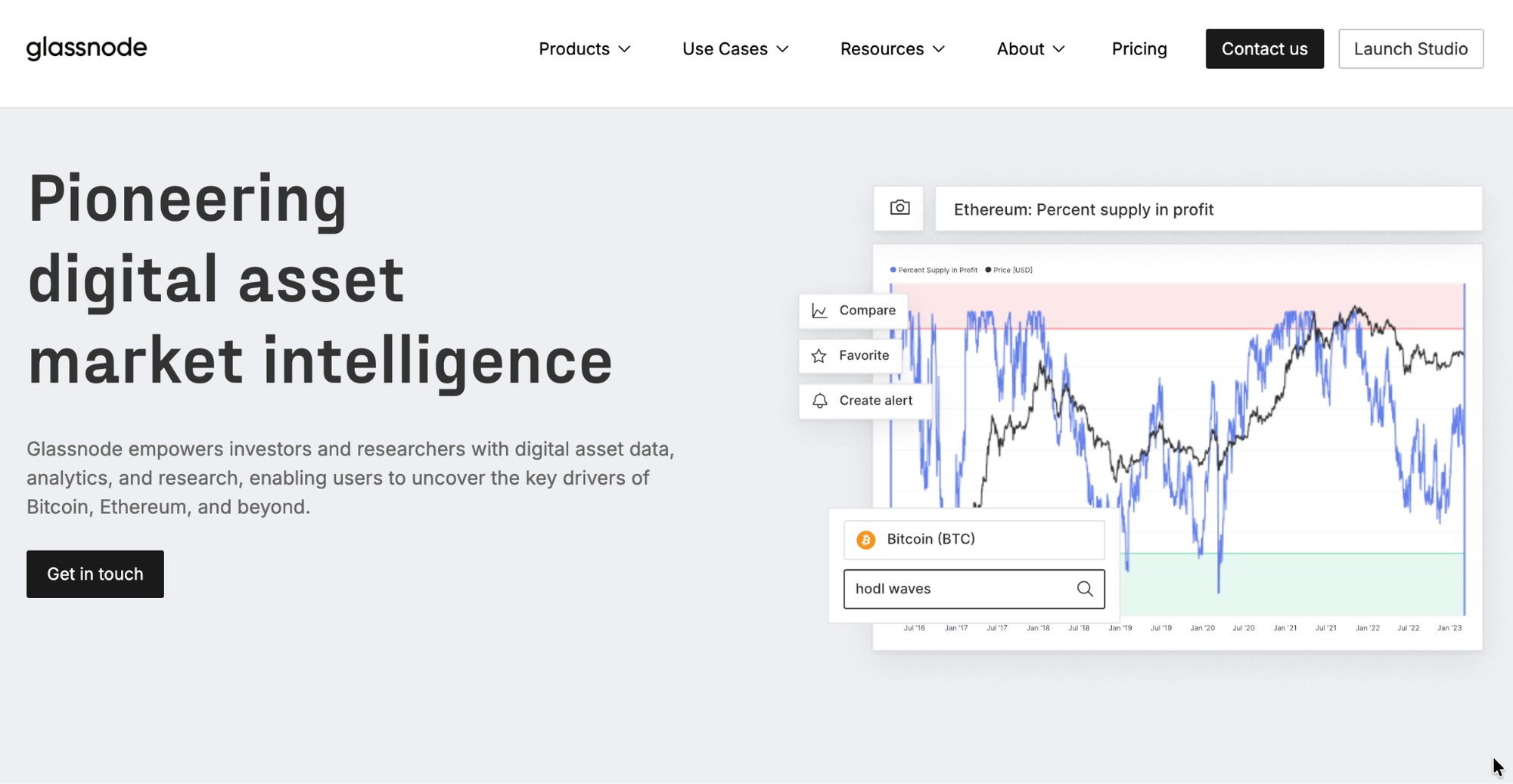
Glassnode is an on-chain analytics platform serving institutional traders, researchers, and funds. The provider focuses on derived metrics rather than raw market data. Coverage includes Bitcoin, Ethereum, and selected additional assets with deep historical archives. Metrics span exchange flows, SOPR, MVRV, network activity, and supply distribution. Pricing is subscription-based with tiers oriented toward professional users. The platform also offers a free tier with limited metric access.
Key Strengths
- Derived On-Chain Metrics: Glassnode publishes hundreds of curated indicators built from raw chain data. These include holder cohort analysis, profit-loss ratios, and exchange balance trends.
- Deep Historical Archives: Data goes back years across supported assets. The depth supports backtesting, cycle analysis, and long-horizon research projects.
- Institutional-Grade Quality: The provider invests in data validation and methodology documentation. Research teams cite Glassnode metrics in market reports and academic work.
Usage Examples
- Market Research and Reports: Pull holder cohort data, exchange flows, and supply metrics. Outputs feed newsletters, fund reports, and analyst publications.
- Quantitative Signal Generation: Use indicators like SOPR, NUPL, and MVRV as inputs to systematic trading models. The API returns clean, timestamped series.
- Risk Management Dashboards: Track exchange inflows, miner activity, and large holder behavior. The metrics inform position sizing and risk reviews.
Glassnode fits institutional analytics, research desks, and quantitative funds. Teams building consumer products or needing broad asset coverage should pair it with a market data provider.
CoinPaprika
General Description
CoinPaprika provides crypto market data through a straightforward REST API. The provider covers a broad list of coins, exchanges, and trading pairs. The free tier requires no API key for many endpoints. That removes signup friction for early-stage prototypes. A paid tier offers higher rate limits and additional historical data. CoinPaprika competes most directly with CoinGecko and CoinMarketCap in the market data aggregator category.
Key Strengths
- Simple Onboarding: Many endpoints work without an API key on the free tier. The path from signup to first call is short and friction-free.
- Broad Coin Coverage: The aggregator tracks tens of thousands of coins, including long-tail and small-cap assets. Historical price data is available across this universe.
- Predictable REST Design: Endpoint naming and response shapes stay consistent across resources. The learning curve stays low for developers familiar with REST conventions.
Usage Examples
- Price Widgets and Tickers: Display live prices, market caps, and 24-hour changes. Use cases include websites, dashboards, and mobile apps.
- Historical Backtests: Pull daily and intraday OHLCV data. The data feeds backtesting frameworks running across a broad coin universe.
- Market Research Tools: Build screeners, comparison tools, and market overview pages. Ranked listings and category filters support these workflows.
CoinPaprika fits developers who need market data fundamentals without heavy infrastructure. The no-key free tier and simple REST design make it especially friendly for prototypes and hobby projects.
Comparison and Conclusion
The five providers profiled cover different slices of the crypto API landscape. The table below summarizes key features.
Final Recommendations:
- For Portfolio Tools, Wallet + DeFi Tracking, and AI Agent Integrations: CoinStats API provides the strongest combination of wallet data, DeFi position resolution, and MCP support. Teams building portfolio dashboards, crypto wallet transaction trackers, and crypto wallet DeFi tools will find the fewest integration gaps here. LLM-powered crypto products and AI agent stacks fit the same data layer.
- For Broad Multi-Chain Data Coverage: Mobula offers wide chain support and SQL query flexibility. The platform suits analytics products, indexers, and custom data pipelines.
- For Blockchain Infrastructure and Payments: CryptoAPIs.io fits fintechs and exchanges that need node access, wallet services, and callbacks under one provider.
- For On-Chain Research and Institutional Analytics: Glassnode delivers curated indicators and historical depth suited to funds, research desks, and quantitative teams.
- For Simple Market Data Prototyping: CoinPaprika offers a low-friction path to market data with minimal setup. The product fits early-stage prototypes and side projects.
The right choice depends on your roadmap, not on absolute feature count. A team building a portfolio tracker needs different data than a research desk modeling Bitcoin holder behavior. A payment processor cares about transaction callbacks, not derived on-chain metrics. The five providers profiled above address these distinct needs. Many production systems use two or three of them together.
As crypto products grow more sophisticated, the underlying data layer matters more. AI agents, multi-chain support, and DeFi position tracking are reshaping what builders expect from a crypto API. Providers shipping strong wallet data, MCP integration, and broad chain coverage have a structural advantage in 2026.
We encourage developers to test multiple providers before committing. Most offer free tiers or trial credits. Evaluation is cheap, switching costs are real. The right tool depends on your specific data needs, latency tolerance, and budget. Each provider profiled above has earned its place by serving a distinct part of the builder market.
References
- CoinStats API - Official Documentation
- Mobula - Official Documentation
- CryptoAPIs.io - Official Documentation
- Glassnode - API Documentation
- CoinPaprika - API Documentation